

by Jane Clare Jones
Rape has long been recognized as a feature of warfare — “martial rape” being, Claudia Card notes, “an ancient practice.”1 Indeed, many of the early chapters of Susan Brownmiller’s classic study Against Our Will (1975) are dedicated to cataloguing rape as a weapon of war and imperial conquest, from the Greeks, through the Crusades and the colonization of the Americas, to the rape of Jewish women by the Nazis and German women by the Russians in the course of World War II. Brownmiller’s historical recitation served an important rhetorical end for feminists and galvanized the anti-rape activism of the second wave. In the everyday peacetime world, the devastating dehumanizing harm of rape is often downplayed, elided by narratives of ravishment, or by comparison to various types of property crime. But there is nothing, Brownmiller sought to underline, ‘romantic’ about rape. And nor is it just an ‘accidental’ act of trespass, or the borrowing of a woman’s bodily property without having quite obtained the proper permissions. Rape is an annihilating instrument of terror. What men do in war tells us that, in fact, they know that perfectly well.
Rape in war is not only embodied terrorism. It is the symbolic expression, perhaps the axiomatic instance, of the territorial logic of patriarchal domination. Within this logic, sexual penetration is synonymous with invasion and conquest, and women’s bodies become the ciphers men use to play out their territorial conflicts with each other. When these territorial conflicts are sedimented through ideas of religious or ethnic difference, rape becomes not only a violent cipher of conquest, but an instrument of corrupting the ethnic or religious purity of the enemy. This was horrifically demonstrated during the 1992-95 Bosnian War — the first time in history rape as a systematic military technique was prosecuted as both a war crime and a crime against humanity. The judgement by the International Criminal Tribunal for the Former Yugoslavia (ICTY) in the case of Kunarac, Kovac and Vukovic (2001) was the result of Serb forces using organized rape camps2 as part of their effort to ‘ethnically cleanse’ Bosnia of its Muslim population — a genocidal campaign that also involved the massacre of 8,000 Bosniak Muslim men and boys in Srebrenica in 1995.
Unimaginable levels of sexual violence were also a major feature of another historic conflict that involved the redrawing of territorial borders. During the 1947 Partition of India, over 14 million people were displaced and up to a million killed, while it is estimated that between 75 and 100 thousand women were kidnapped and raped. As Ritu Menon and Kamla Bhasin tell us in Borders and Boundaries: Women in India’s Partition, during the intensely violent process of creating distinct sovereign territories out of the intermingled Muslim and Hindu populations of the subcontinent, women of the ‘other’ side were subjected to “stripping; parading naked; mutilating and disfiguring…knifing open the womb; raping” and “killing fetuses.” The violence was directed at women’s bodies, Menon and Bhasin argue, as “territory to be conquered, claimed or marked by the assailant.”3 In the words of Paola Bacchetta, during Partition women became “geo-politicized” symbols of their “respective religious ‘communities’…dualistically positioned as either ‘ours’ or ‘theirs’ and, accordingly, encoded as sites for masculinist protection or desecration.”4
These acts are a stark mixture of the symbolic and the materially genocidal. As Bacchetta argues, rape represents the conquest of a nation through “forced penetration of its softened flesh/borders,” while attacks on women’s reproductive capacities “signify genocide.”5 Similarly, the Bosnian rape camps were both an instrument of terror, intended to drive Muslims out of territory Serbs aimed to conquer, and a symbolic and material attack on the integrity of Bosnian Muslim culture and ethnicity. According to Debra Bergoffen, the Serbian assault depended on patriarchal assumptions shared by both groups about the role of women as reproductive vessels for the nation, the effort to corrupt the Muslim community through forced impregnation depending on the shared belief that the mother’s purity was key to her role in ethnic reproduction. As Bergoffen writes, a “mother neither determined the identity of the child…nor decided its place in the community’s future,” but a “polluted maternal body would contaminate the embryonic material and render it unfit to receive the cultural imprints provided by the father.”6
In 1992, the Slovenian journalist Vlasta Jalusic observed how ethnic conflict in all the former Yugoslav republics involved invocations of a “blood and soil” femininity that positioned women as the “biological regenerators of the nation.”7 In The Body of War (2007), Dubravka Žarkov analyses how both the sexual atrocities and the media’s propagandist representation of those atrocities played a crucial part in producing the ethnic ideals which came to define the conflict between Serbs and Croats. Heralded by the 1990 suggestion that Serbia’s ethnic purity needed to be protected by “a chastity border belt,” Žarkov traces the way that “national and ethnic groups became personified” during the course of the war, and “notions usually associated with…sexuality were suddenly associated with matters that concern state territory, daily politics and…ethnicity.”8 The media’s representation of the conflict and its “persistent linkage” of “raped female bodies with specific ethnicity and territory” served as a mechanism of separating peoples into distinct groups and was central, Žarkov argues, to “establish[ing] a particular ethnic geography.”9
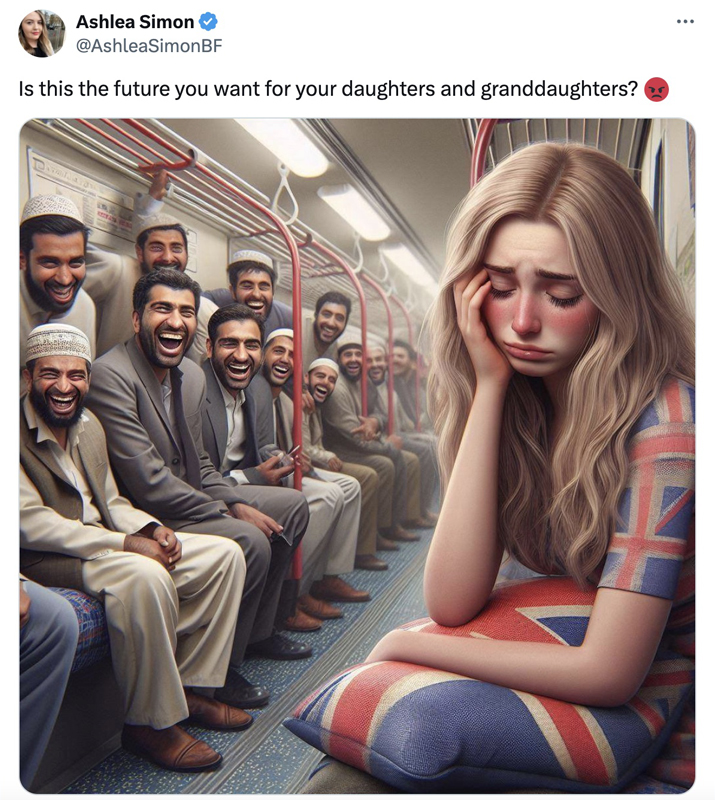
Rape in war thus not only functions as a symbolic and material expression of territorial or ethnic conflict and genocidal intent, but the representation of rape in war can also be part of the mechanisms that re/produce the basis of the conflict itself. Representations of sexualized invasion and reproductive threat are also playing an important role in the racialized and territorial grammar of contemporary populism, which variously mixes images of inundation by small boats, the danger posed by refugees, discourses about ‘rape jihad’ and grooming gangs, concerns about declining ‘Western’ (that is, white) birth rates, and the contours of Great Replacement Theory. This kind of logic played a substantial role in the Brexit campaign, as illustrated by a controversial 2014 poster by UKIP depicting the border of the United Kingdom — represented by the pure white cliffs of Dover — being penetrated by a dark, distinctly phallic-shaped escalator. Some ten years later, as populist movements gain traction across Europe, representations of foreign immigrants as a sexualized threat to the purity of the nation, often imagined as the innocent bodies of young women, have become increasingly unsubtle. The once relatively fringe rhetoric about immigration as ‘The Rape of Europe’ that impelled Anders Behring Breivik to commit mass murderer in 201110 have now seeped thoroughly into mainstream populist discourse.

As Rose Rickford suggests in our conversation ‘On the Heart of the Boundary’, the deployment of tropes about the sexual threat of the ‘other’ confronts feminists with a profound tension. All feminists have a fundamental duty to stand against acts of sexual dehumanization and to call out the patriarchal violation of women’s bodies in all its iterations. Our commitment to represent the interests of all women, and to resist the patriarchal instrumentalization of feminist-sounding rhetoric, means, however, that we also have a duty to stand against selective political concern for ‘protecting’ women when its primary intent is to dehumanize entire groups of human beings. This kind of instrumentalizing ‘collateral feminism,’ as G. H. calls it in ‘Women’s Bodies Become a Battlefield’, often “becomes the justification for more of men’s violence” and colluding with it damages the ethical integrity of feminist work and solidarity between women across patriarchal battle lines. Notably, the critique of this kind of rhetoric has been used as ammunition by the academic and identitarian left over the last two decades to monster and generically dismiss radical feminist opposition to male sexual violence as necessarily complicit with racialized and colonial logics of othering. In conditions of ever-more-vitriolic culture-war polarization, conditions in which, very often, neither left nor right identitarians have any genuine concern for the devastation to women wrought by sexual violation, trying to negotiate this tension can sometimes feel intolerable.
Here we must try to remember that both the use of sexual terror as an act of conquest and the representation of sexual terror as an act of conquest are products of the sovereign logic of patriarchy and the dehumanizing use of women’s bodies as ciphers of the purity of the nation or the racialized tribe. All groups of patriarchal men have used, and continue to use, rape as an instrument of terror against the women of ‘other’ groups, and despite the chivalrous conceits of the patriarchal protection racket, such men are reliably violent to their ‘own’ women as well. Anyone who claims that the sexual threat posed by a specific ‘other’ group of men makes them uniquely barbaric and inhuman should be treated, prima facie, with suspicion. Above all we must keep asserting that women are not countries but human beings, and that the boundaries of their bodies limn the edges of their personhood, not the borders of the nation. Violations of those boundaries are not acts of territorial conquest. They are crimes against the humanity of an individual human subject. We must hold fast to the recognition of every instance of that human devastation, and, at the same time, we must keep refusing the instrumental reduction of that devastation to a symbol inside patriarchy’s territorial logic, with all the catastrophic conflict it creates.
1 Claudia Card, ‘Rape as a Weapon of War,’ Hypatia, 11.4 (1996), 5-18 (p. 5).
2 Alexandra Stiglmayer, ‘The Rapes in Bosnia-Herzegovina’ in Mass Rape: The War Against Women in Bosnia-Herzegovina, ed. by A. Stiglmayer (Lincoln and London: University of Nebraska Press, 1994), pp. 82-169.
3 Ritu Menon and Kamla Bhasin, Borders and Boundaries: Women in India’s Partition (New Delhi: Kali for Women, 1998), p. 43.
4 Paola Bacchetta, ‘Reinterrogating Partition Violence: Voices of Women/Children/Dalits in India’s Partition,’ Feminist Studies, 26.3 (2000), p. 571.
5 Bacchetta, p. 572.
6 Deborah Bergoffen, Contesting the Politics of Genocidal Rape: Affirming the Dignity of the Vulnerable Body (New York and London: Routledge, 2012), p. 12.
7 Ruth Seifert, ‘The Second Front: The Logic of Sexual Violence in Wars,’ Women’s Studies International Forum, 19.1-2 (1996), 35-43 (p. 41).
8 Dubravka Žarkov, The Body of War: Media, Ethnicity and Gender in the Break-up of Yugoslavia (Durham and London: Duke University Press, 2007), pp. 1-2.
9 Žarkov, p. 153.
10 Jane Clare Jones, ‘Anders Breivik’s chilling anti-feminism,’ The Guardian, 27 July 2011; Kristin Engh Førde, ‘Ideals of purity create misogyny,’ Kilden, 9 September 2011.