

by Linda Napikoski
Why is there something so male about sports in the United States? It’s not news to anybody that sports culture and consumption are often quite male. But consider: why is there such a hyper-maleness to the participation in and discourse surrounding sports? What should seem in any way ‘obvious’ about health, fitness, competition, entertainment, and camaraderie being for only one half of the human species?
THE SPORTING WORLD: OF THE MALES, BY THE MALES, FOR THE MALES
First and foremost, there seems to be an underlying acceptance of boys and men being better at sports. Are they, though? Or is it that the sports are better for the boys?
Sports talk in the USA often revolves around teams in the ‘Big Four’ popular professional sports leagues: Major League Baseball (MLB), the National Basketball Association (NBA), the National Hockey League (NHL — in this one United Statesians share a bit more of the glory with Canada), and the National Football League (NFL). Pervasive media coverage of these four sports focuses on men, and they have been played mostly if not solely by men at the professional level. What we forget, being so aware of all the men who have excelled, is that throughout the years, these widely popularized sports developed and were optimized for the male body. When “it has been the men!”1 inventing sports, and it has been the men running sports leagues and coaching teams and drafting talent, and it has been the men finessing the rules and the gameplay (as well as the performance-enhancing drugs and the cheating) for decades, why does it surprise anyone that men are then ‘better at’ their sports—the sports tailor-made for their bodies?
To see this clearly, think about my favourite sport, gymnastics, a quite different athletic endeavour where more women than men are household names in the USA. Gymnastics unequivocally recognizes differences between male and female bodies in its very set-up, with men and women competing in different apparatus events. Floor exercise and vault are for both sexes, but women have uneven bars while men do high bar and parallel bars, and women compete on the balance beam, while men have the rings and the pommel horse. Lo and behold, unlike with so many other sports, the majority of participants in youth gymnastics in the United States are female. Imagine! Is there any wonder that a competition optimized for the reality of the female body sees higher female participation?
Yet, even gymnastics, with its separated male and female body types and ample participation by girls, generally sees girls age out of the sport earlier than boys, and earlier than the girls themselves would in other sports. Most women gymnasts leave elite competition before full-on adulthood — thus precluding society from even dealing with the question of having to enthusiastically hype and invest in a sport optimized for mature female bodies. This is because the wear and tear on the body is excessively demanding, and because the skills in female gymnastics as it is practised and coached these days are more easily accomplished by and designed for young, petite bodies. Male gymnasts, on the other hand, relying on their male upper-body strength in so much of their side of the sport, benefit in gymnastics from going through puberty, whereas practising gymnastics often staves off puberty for some girls and young women.
In the Big Four professional leagues, we often have a kind of chicken-or-egg conversation about the lack of women: why aren’t there more (or any) women in this sport, which is not for women? And are men better at this sport, which doesn’t have any women in it? And so on. Baseball, which we lovingly refer to as our national pastime, is so specifically designed for the male body type that females play a different version of the sport, softball.2 But softball is also frequently played by men recreationally, while women almost never play recreational or professional baseball. (That’s what makes the 1992 movie A League of Their Own so notably charming.)3 We love baseball in the USA. It’s by far my favourite team sport to watch, and always has been. I remember telling my mother when I was nine or ten years old that I was going to be the first woman to play baseball in the Major Leagues. She, also a lifelong baseball fan, must have laughed. What I did play at that time was softball.
The two versions of the sport differ in size of ballfield, distance between bases, and length of bats, plus baseball pitchers throw from an elevated mound, while the softball pitcher throws to the batter on a literal level playing field — but the main observable difference is overhand vs. underhand pitching. A baseball pitcher pulls his arm back behind his body and throws the ball overhand — usually upwards of 90mph in the major leagues. Male upper-body strength plays a large role in baseball; indeed, we had a whole disgraceful ‘steroid era’ that altered how we look at some of the home-run-hitting achievements of the 1990s.4 A softball pitcher throws underhand, at a slower speed but with a wind-up for added force. Much of the power comes from the female pitcher’s lower body and leg strength, not just her arm.5 You’d imagine this obvious difference in pitching might lead people to note that men’s and women’s upper body strength function differently, which doesn’t have to mean better or worse. Like a female gymnast on the balance beam compared to a male gymnast on the rings — aren’t male and female baseball and softball pitchers using their different bodies to do different, amazing things?
Instead, we find in baseball and softball discourse a familiar pattern of misogyny: baseball has a professional league played on the world stage with legendary athletes; softball is vaguely considered either the girls’ version, or, occasionally, the lesser version, which anyone male or female can play in a pick-up game in the park or at the company picnic. Of course, in these low-stakes games, no one is hurling elite-softball-strength pitches at their co-workers; the casual softball player with friends is as different from the university softball champion as from the Major League Baseball champion. But the hierarchy is there, subconsciously: baseball = men, strong, pros; softball = women or anyone, amateurs.
And, rather than as a society thinking, ‘Isn’t it interesting that the mechanics of male upper bodies lend themselves to baseball pitchers throwing strikeouts and fastballs and no-hitters, and football quarterbacks throwing touchdowns?’ we instead grow up with an ever-present taunt from boys who don’t want us to play with them: “You throw like a girl!”
In 2014, then-13-year-old Mo’ne Davis became briefly famous as the first girl in baseball — not softball — to pitch a shutout game (not allowing the other team to score even one run) in the Little League World Series.6 Her achievement was unique and inspiring. Publications came up with clever headlines playing with the ‘throw like a girl’ cliché. Davis is now playing collegiate softball — but no longer pitching, because the mechanics of softball pitching are totally different, she noted. Once our bodies develop through puberty and those male and female musculoskeletal structures start doing their thing, you can see how aspects of sports optimized for men don’t work the same way for women.
Meanwhile, when the softball pitcher Jennie Finch was at her peak, she would amiably play along and pitch to Major League male baseball players in celebrity softball games or fun TV segments, demonstrating that even the best sluggers couldn’t hit the ball when she pitched to them.7 The lesson? I suggest: softball players are highly skilled, and the sports differentiate themselves with different male and female bodies excelling differently … but, naturally, real-life coverage of Finch striking out all the men took a tone of ‘Oh, it’s all in fun — these men aren’t used to seeing a pitcher like this — we’re not saying she’s actually better than these abashed men, don’t worry!’ (I paraphrase.)
Thus, even when we in the US have a variant sport, like softball from baseball, we still somehow find little ways to position the men above the women in the ever-present sports hierarchy. And we never seem to go all in and invent a sport designed for women’s bodies.
But we certainly have a sport for male bodies only … Are you ready for some football?!8
Football — that is, (North) American football — is an often-thrilling sport that finds quite strong men displaying incredible feats of athleticism that are dangerous and lead to numerous injuries.9 To watch football at the college or professional level is to watch the human body handle challenges with speed, strength, agility, and raw power. It is also to watch concussions, routine painful hits, slamming together of helmets, and big male bodies tackling one another up and down the field on the way to the end zone. It’s no place for a girl.
I mean that earnestly and not in an infuriating way. Occasionally, a female plays competitive football — in high school, or far less often, college — usually as the kicker only (restarting play from the midfield 50-yard-line after a score or a half). But the bulk of the sport is made for the male body. In elementary school physical education, we play flag football, where instead of tackling you pull the flag from around the opponent’s waist to ‘catch’ them. When the kids get a bit older and the boys move on to ‘real’ tackle football, it’s time for the girls to learn about cheerleading.
I, for one, have over the years come to dislike many things about the NFL—the sweeping under the rug of the concussion issue, the racism directed at some players, the hyper-militarized pre-game patriotism spectacles, and the pervasive reports of domestic violence accusations against players that the league seems unwilling to address—far more than the exclusion of women from the sport. I ask, would it necessarily be bad to have a sport that is just for men — if — if only! — there were also a sport just for women? Instead, what do we offer girls, when the boys start playing football? Girls compete to perform on the side-lines in short skirts, cheering the boys on.10
FEMALE ATHLETES ARE SEXUALIZED AND DEVALUED BY SOCIAL CODING
Does the answer to our question — why is there something so enthusiastically male about sports in the United States? — have to do with patriarchal culture placing value on women’s bodies only when we are performing or working for the benefit of men? A culture with no use for women’s bodies when we are fulfilling ourselves? Is it because we are so subconsciously used to all the ways we are taught to judge the women’s bodies that we look at (in movies, on magazine covers, at the beach) that we truly are no longer capable of looking at women’s bodies without sexism and unfair expectations?
Let’s look more closely at cheerleading. In the social jockeying that is the American high school, the mythical equivalent to the handsome, popular, sought-after high-school football quarterback is the girl who could become head cheerleader. Even if we disregard the weirdness of a sport that consists of cheering on other players (who are male), the glamorous dream job is quickly revealed at the professional level to be a nightmare. Being scantily clad is only one of the problems. NFL cheerleaders sign contracts riddled with questionable provisions, and are scrutinized in their schedules, movements, public appearances, social media, dress, hairstyle, and weight. All this while a season’s cheerleader pay doesn’t even average out to minimum wage. Several lawsuits have been brought against the NFL; one alleging wage theft and illegal employment practices was settled with a payout of $10,000 to an Oakland Raiderette.11 Meanwhile, the lowest paid NFL (male) football player gets at least $600,000 per season. That’s a guaranteed minimum in the league’s collective bargaining agreement. Of course, the big (male) stars earn millions.
Cheerleaders are generally expected to be pretty, thin, and perfectly made up; there are specific physical requirements in the job description. The cheer squad is performing a visual show — as if the objectifying gaze is the point. We should note that this gaze is not limited to the ‘side-line’ activity of cheerleading: females in other activities such as beach volleyball, beach handball, gymnastics, also show plenty of skin and — crucially — have been thwarted if and when they try to wear uniforms that cover more skin. Likewise, in cheerleading you have ‘a bunch of pretty girls’ who actually exhibit really impressive physical feats. They truly aren’t just cheering for the boys; they incorporate dance, gymnastics, and complex choreographed routines that require a high level of fitness, ability, training, and skills practice. There have often been debates about whether cheerleading is a sport, but these miss the point: it’s not about whether or not this is intense athleticism and physical performance (it undeniably is), but that its very construct is a group of women who are here to cheer on the men who are playing the actual game.
If there is anything more symbolic than that in the wide world of sports, I’m not sure what it is. From an early age, the message is: ‘You’re not interested in sports. You’re interested in supporting male sports.’ Newborn onesies can, of course, be worn by babies of either sex. But in ubiquitous US mega-retailer Walmart’s baby clothes shop, playing a sport is designated a ‘Newborn Boys’ item. From (actual) day one. They can’t hold up their heads, much less a baseball bat or pom-poms.
There are actually male cheerleaders, too, especially at the college level with its halftime performance extravaganzas. But the image of football boys and cheerleader girls starts early and sticks. There are a few other high school sports with cheerleaders — usually basketball, occasionally wrestling — that don’t fall into such a quarterback/cheerleader polarization. But at anything other than the NBA level, the basketball cheerleaders are not perceived as much of a big deal. In middle school and high school, the basketball cheer squad is a sort of afterthought to the football cheer squad. I like to think part of why basketball cheer is less of a thing is because girls can just go play basketball instead of only having the option to cheer for the boys.
Of course, bodies are seen and, to an extent, scrutinized in every sport, but along with physical achievement, women are — surprise! — subjected to pressure to appear pleasing to the (presumed male?) viewer. Sure, competitive female gymnasts are encouraged to be tiny partly because of how the sport works, that is, the laws of physics and muscle strength needed to propel a certain amount of weight in the air. However, you can’t get too curvy without drawing commentary and the f-word (‘fat’) from armchair critics, and it’s widely whispered that eating disorders among gymnasts are not uncommon. There are also the leotards. Now, leotards are quite comfortable and work well for competition, but as a now-cynical adult, I can only imagine that some eyeballs on gymnastics are gazing at the young women instead of watching their incredible strength. I was overjoyed to see German gymnasts at the recent European Championships compete in full body suits, a public statement against sexualization in the sport.12 This pressure and unwanted sexualization has had devastating consequences for girls in USA Gymnastics in recent years. In very recent memory, a group of 200 gymnasts, including Olympians, sued USA Gymnastics and made Larry Nassar infamous for his pervasive, catastrophic sexual abuse of the young gymnasts.13 I love that women’s gymnastics is consistently one of the USA’s most-watched Olympic events, but it disturbs me to think about people watching the girls just to gaze on pretty female bodies, not with expectations of greatness.
And how often do girls experience expectations that we will be great athletes? My freshman year of college, I took skiing, an elective physical education class that was solely for fun and offered little in the way of degree progress — it was an excuse to hit the nearby slopes every week! At the first class meeting, we sat around in some campus room to divide into groups based on skill level. The (male) leader stood in front of the class as we looked over a questionnaire. The significant task was to rate ourselves on a scale of 0 (never been on skis) to 10 (expert). My dorm neighbour and I sat next to each other, both hesitant about whether to mark our past-advanced-beginning selves as level 4 or level 5. The instructor informed us all what to do if we were hesitating between two levels: “If you’re a guy, go ahead and put the higher level.” Females? “Might want to mark the lower of the two you’re considering.”
You can be damn sure that in that instant, my friend and I quickly decided to circle level 5, with all the spite we could muster. I think about that instructor from time to time. In a way, he was demonstrating something true. It’s not that men are ‘better’ at skiing than women, or even whether that matters, but in his experience, he could rely on the men to handle themselves in a physical challenge even if it seemed a bit beyond their reach, because they’d had 20 years of being fully socialized and conditioned to do just that. Despite my lifetime of trying new activities and occasional fearlessness, I can testify that I have not been socialized and conditioned to demand more of myself in athletic endeavours.
FOLLOW THE MONEY – AND IT WILL LEAD YOU TO MEN’S SPORTS
As if the built-in bodily advantages weren’t enough, the professional team sports have barely found it in themselves to be open to women’s play. There were years of boys’ teams before Title IX legislation brought girls’ scholastic sports teams into widespread existence. With rare exceptions, the big university alumni dollars are buoyed by the glory national audiences find in men’s basketball and football. Professionally, sports means ‘men’s sports’ to most people — and that’s not their blind spot. It has been the men’s sports that are presented to them to love. Just as it is to the boys that the sports have been presented to play.
Unfortunately, we don’t throw money or national, event-viewing, commercialized attention at any women’s sport. The nation as whole pays attention to women athletes only every four years at the Olympics. Tennis, another sport with famous, admired female stars, is also a sport that exists only in occasional tournaments for most of the US public. There are plenty of fans of these specific sports who do follow them, but the star-making, money-making coverage is limited to the men’s Big Four. I believe that the strongest driving forces behind television sportscasting, fan clubs, posters and jerseys and sneakers, the forces that cultivate and reap the rewards of massive, large-scale interest in athletic contests, simply have yet to conceive of what a nation of prominent women’s sports would be like.
We throw money and attention — lots of it — at a handful of team sports, with by far more emphasis on men. The Big Four US sports leagues have leaned in to their maleness for years, on the playing field and in the accompanying beer and Viagra television commercials. Now, of late, we are grudgingly adding a ‘big fifth’ sport, Major League Soccer — and the cities and networks are doing their part to grow the fan bases and provide enthusiastic coverage.14 For all our reputation as being the one country in the world to not like soccer (and to call a different sport ‘football’), the United States actually doesn’t dislike the ‘beautiful game.’ Everyone, boys and girls, plays soccer right along with our other sports in elementary school physical education class and on the playground with friends; millions of kids play in youth soccer community leagues, with hundreds of thousands of high school players.
But here is where things get interesting: at this point, a lot of ‘regular people’ in the US can tell you more about the women who are soccer stars than they can about the soccer men. The US women’s national team has made itself a force to be reckoned with, not just for winning World Cups but also as a powerful voice for equality, with their lawsuit over discrimination in pay and other working conditions compared to the men’s national team. 15 The women’s strength on and off the field has created actual recognizable, famous, professional female celebrity athletes, from Mia Hamm to Megan Rapinoe — a bit of a rarity in the US. Big-time professional sports dollars remain quite male, and it remains to be seen whether women’s soccer will be the professional league that finally upends that dynamic — and whether a certain strain of the manly male sports public discourse will find a misogynist way to interpret that to the detriment of soccer’s potential breakthrough US success.
As for the current Big Four, basketball is the only one with any place for women at the national level, in the WNBA, but there is still a clear and present disparity.16 LeBron James — King James, as he is sometimes called or calls himself — is recognized as the greatest current basketball player and maybe even as great as (better than?!) Michael Jordan, depending on whom you argue with. Sue Bird in the WNBA has the same number of championships as LeBron. There’s a viral meme that makes the rounds:
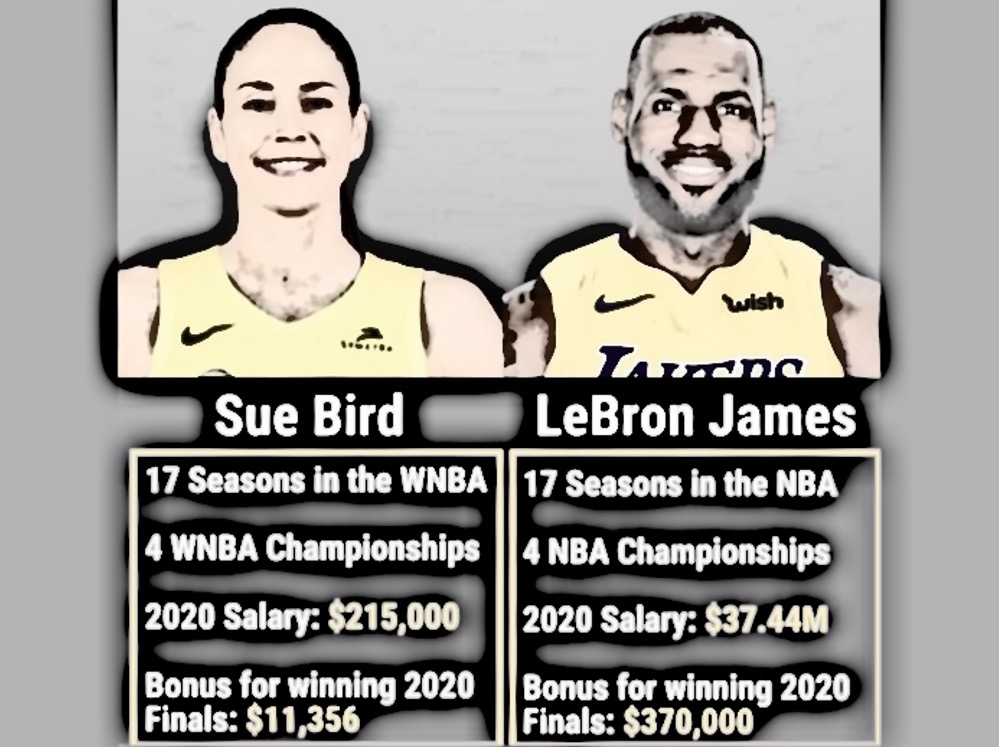
Sometimes people respond, “Oh yeah, well, who brings in the money?! LeBron!” Well, yes. In the heavily televised, promoted, sponsored men’s NBA, more money is brought in than in the WNBA, where players get a fraction of the exposure. We’re begging the question. We have no earthly idea what kind of wide world of women’s sports could be created if we created it instead of insisting that it doesn’t exist.
There is no sport where women are given a LeBron James-level opportunity. The Big Four (male) sports are a world of multi-million-dollar salaries, legendary Halls of Fame, celebrity lifestyles, and an unquestionable sense of having ‘made it’ after putting in years of hard work. Financially, though, besides ridiculous seven-plus-figure dollar amounts in contracts, there are players’ unions, contract negotiating, and collective bargaining. Is sports compensation just like so many other, mundane professions, where women are known to ask for and receive a lower salary, while men confidently take what they can get even when their actual performance is mediocre?
The disparity in funding and promotion exists at college level, too, and even younger. The best athletes most often start young, and boys are given more time and more facilities to play sports than girls are. We were all reminded of this (not that we’d ever really forgotten) during the most recent March Madness college basketball tournament. March Madness is a joyous annual ritual wherein the National Collegiate Athletic Association (NCAA) creates a nationwide frenzy by whittling a field of 64 university basketball teams down to a Final Four and eventual champion. Millions of people, from bored office workers in cubicles to (even while he was president) Barack Obama, fill out their March Madness brackets every year, either on paper or more commonly now on websites, picking a winner in each match-up from the first Round of 64 through the final game, scoring points or winning wagered money with each correctly picked entry. We compete with friends or strangers in betting pools to correctly pick as many bracketology match-ups as possible.
The vast majority of this frenzy is reserved for the men’s tournament. The NCAA, television networks, and schools who have champion or even reasonably good women’s teams make a half-hearted effort to remind everyone there is also a women’s tournament happening at the same time, but they never quite mount a full-court press effort on behalf of the women.
Well, the NCAA tournament was COVID-cancelled at the last minute in 2020 as the world shut down, so it was extra thrilling for us to have our annual Madness rituals return in March 2021. This year, instead of playing in different regions and traveling to a new city the next weekend if a team advanced, the tournament took the pandemic-bubble approach, all athletes staying in one city, with testing protocols and teams in hotels together travelling only between lodging, practice space, and arena.
During the first week, we learned that boys are given better athletic training than girls. University of Oregon women’s basketball player Sedona Prince took to TikTok and Twitter to show the world the women’s ‘weight room’ in their bubble in San Antonio; it consisted of a set of dumbbells and a stack of mats on a cart, which she juxtaposed with a video of the men’s weight room facility in Indianapolis, a vast space filled with rows of various equipment and set-ups, as you might expect a moneyed entity to provide for elite athletes at the pinnacle of their season.17 As one reporter noted, the women “have six dumbbells and yoga mats — the men have Planet Fitness.”18 It caused a viral stir for a few days; the NCAA, on the defensive, apologized — but as Prince added at the end of her social media video, “If you aren’t upset about this problem, then you’re a part of it.”19
Responding to the intense criticism, the NCAA commissioned an external review, hiring a New York law firm to investigate the problem. The resulting lengthy Gender Equity Review notes, among other findings, that the NCAA has been “significantly undervaluing women’s basketball as an asset.”20 You don’t say! The report specifies that in unequal dollar amounts spent on promotion, signage, and advertising, as well as in competitive bidding for broadcast rights, the NCAA has “skewed” the numbers, while claiming that the men’s tournament generates more money and the women’s tournament loses money.21 In other words, it has been one big self-fulfilling prophecy, in the NCAA as in the pro leagues, and, too often, in the hearts and minds and bodies of athletes throughout the nation: a blithe assertion that the women’s sport won’t generate as much money or interest, followed by a concentration of all money, time, prestige, recruitment, in the men’s sport, followed by a very problematic ‘See?’
AS THE NEW YORK METS ONCE TURNED INTO A RALLYING CRY: “YA GOTTA BELIEVE!”
I’m not sure what, specifically, men are afraid of ceding. Money, and with it, power? Notions of physical strength? Are they afraid that women as athletes will usurp the men’s place in some basic, age-old sexism of marching off to war, or hunting, or some evolutionary holdover? Fame? Glory? Being the correct answers to sports trivia questions?
We occasionally make strides in widespread public acceptance of a need to level the metaphorical playing field for women in, say, corporate board rooms, Hollywood film directing, professions such as medicine, law, and even politics, or in basic wage and salary equality. Perhaps the undercurrent in all of those is the idea that ‘a woman can be just as good a _________ as a man’ (whether that’s CEO, lawyer, doctor, senator, president … maybe someday), because those accomplishments don’t ask anything overtly bodily of the different body types. The thrust of those arguments, even when unstated, seems to include the idea that X woman’s mind is just as good for leading, managing, CEO-ing, and so forth as Y man’s mind is, specifically not caring about one’s upper body capacity to do push-ups and chin-ups. But when a woman steps onto a literal playing field, now we are facing inequality that, in fact, confronts bodily reality — the hows and wherefores of men’s and women’s differing bodies.
We have learned, and we continue to learn and learn and learn, that many people are deeply unable to reckon with this difference of body types in sensible, progressive, or rational, let alone problem-solving, ways. We easily swallow the idea that men are better at playing these games invented for their bodies because their bodies are better, instead of interrogating the ‘invention for’ part of the equation. We reward the men who play these sports with media, money, attention, and acceptance, then seem perplexed as to why women who play sports just don’t get as much media, money, attention, and acceptance.
We have no idea what women in big, professional sports could possibly be capable of if they were promoted and marketed to the same degree, and given access to the same facilities, conditioning workouts, and development, but also if they hadn’t lived a life of social coding that tells them men play sports, men talk about sports, men are good at sports, women don’t, women aren’t.
And, when girls do play sports, they encounter things like the day I vividly remember, when my eighth-grade girls’ soccer team practised with the boys’ team for a day: the boys’ coach worked us so hard in conditioning, stamina, and just general level of demanding performance that I walked away a changed adolescent, thinking, “Why doesn’t our coach push us that hard? Doesn’t she want us to be good? Is she afraid to?”
Society perpetuates the misogynistic view that boys and men should reap the benefits of health, fitness, teamwork, camaraderie, leadership, personal growth, and perseverance to be gained from playing a sport, but that women aren’t interested in or worthy of any of it.
Notably, I have found one glimmer of hope. In a recent debate about who is the Greatest of All Time, brought on by football quarterback Tom Brady winning yet another Super Bowl championship ring, quite a few people suggested the athlete G.O.A.T. might be Serena Williams or Simone Biles. A tennis player and a gymnast, not part of the Big Four — and two women in the conversation! Refreshing.
Tennis pros, gymnasts, other Olympians, and of late the great US women’s national soccer team have become household names and sports legends. But, as one of the endlessly quoted movie lines from a national (male) pastime flick reminds us, “If you build it, he will come.”22 First you have to build it: the fan base, the commercial money, the infrastructure.
The belief. You have to build the belief.
You have to believe that each woman’s bodily self matters — not because she is a mother, daughter, wife, sister, and so on, but because she is a self — and that of course she should be able to act and play and celebrate as her bodily self.
You, the spectator, have to believe that women’s bodies can be in the spotlight without being gazed upon. They can be watched, enthusiastically — enviously, even. They can be admired, praised, and coveted, without the watching becoming the ‘othering gaze.’
You, the female athlete, have to believe that your body can accomplish incredible things in its own right.
You, the television network or streaming executive, who can make people binge-watch really any subject matter, have to believe that creating the demand (which you will then supply) for women’s sports is a worthy, money-making endeavour.
You, the middle-school soccer coach, have to believe that your girls’ team wants to be pushed to its utmost at practice. Every day.
You, the baby-clothes buyer, have to believe that a newborn baby girl is a future athlete.
1 I hear this as television sitcom Designing Women ranter-in-chief Julia Sugarbaker, played by Dixie Carter, famously noting in the battle-of-the-sexes episode ‘Reservations for Eight’: “It has been the men who have done” so much of the “mischief-making” of world history, so, she concludes, “if the world isn’t quite what you had in mind,” gentlemen, “you have only yourselves to thank.”
2 Some people will call softball a ‘variant’ of baseball; some will say they are two different sports; some will say they are two versions of the same sport.
3 A League of Their Own, dir. by Penny Marshall (Columbia Pictures, 1992), Tom Hanks, Geena Davis, Rosie O’Donnell, Madonna—and the beloved catchphrase: “There’s no crying in baseball!”
4 Many professional baseball players are thought to have used steroids or performance-enhancing drugs from the 1980s through the early 00s; some have admitted it; some have demurred but talked of steroids as an open secret; some players have asterisks by their name in the Hall of Fame and in their fans’ hearts. See ESPN, ‘The steroids era,’ 5 December 2021.
5 Research suggests that women and men don’t just move their arms differently, but rotate their shoulders and hips differently when throwing, too. These differences of rotation can also be found in tennis. See Colin Lecher, ‘FYI: Why do girls throw like a girl?’ Popular Science, 18 September 2012; Bob Cook, ‘Why your daughter throws like a girl,’ Forbes, 11 September 2012.
6 Mitchell Northam, ‘Mo’ne Davis, former Little League World Series star, makes her college softball debut for Hampton,’ NCAA, 9 February 2020.
7 Jugs Sports, ‘A women’s softball pitcher vs. the top baseball hitters … Who wins?’ 27 August 2018.
8 This slogan is part of the intro/song/hype of the Monday Night Football broadcast, a popular programme in the US for decades.
9 See also the movie Concussion, dir. by Peter Landesman (Sony Pictures, 2015), starring Will Smith as Dr Bennet Omalu, who tried to expose information about the brain damage that results from normal football play, and who was fiercely fought by the NFL and their billions.
10 I get a little feminist rage every time I hear John (Cougar) Mellencamp’s still wildly popular classic rock song Jack and Diane: “A little ditty about Jack and Diane/Two American kids growing up in the heartland/Jack, he’s gonna be a football star/Diane’s a debutante in the back seat of Jacky’s car.” It expresses way too much way too perfectly about what boys and girls are encouraged to value about themselves.
11 Ben Church, ‘If I would have known then what I know now, I would have never stepped foot in the NFL,’ CNN, 17 January 2020.
12 BBC, ‘German gymnasts’ outfits take on sexualisation in sport,’ 23 April 2021.
13 New York Times, ‘U.S.A. gymnastics offers $215 million to Larry Nassar victims,’ 30 January 2020.
14 My theory as to why it hasn’t heretofore cracked our Big Four is that advertisers didn’t know how to commercialize it, to promote and shove it down our throats via television, because—an uninterrupted 45-minute half? That’s madness! We like our sports with commercial breaks! Baseball has commercials at half-innings and innings’ end, plus during pitching changes. Hockey, basketball, and football have timeouts. They even have ‘TV timeouts.’ I always imagine a table of (male) broadcasting executives in the US sitting around a boardroom table saying, “45 minutes? Plus stoppage time? Even if someone’s writhing on the field, the clock just keeps going? But when do we advertise?!?!” in a kind of primal wail. With the advent of in-home digital video recording and playback, streaming, and cutting the cord with cable television provider companies, broadcasters and sponsors had to find ways to reach people who were viewing things differently, and now ‘suddenly’ soccer is growing in popularity. Really, it’s that they have ‘suddenly’ (finally) been forced to figure out ways to throw their money at Major League Soccer and make it become more money; so now the MLS could potentially become our fifth Big Sport.
15 Anne M. Peterson and Ronald Blum, ‘Women’s team, US Soccer settle part of their lawsuit,’ AP News, 2 December 2020.
16 You’ll see that telltale ‘W’ a lot in sports, reminding us who the second sex is, and who is the default; the NBA is just the NBA, of course, and there’s no calling it the MNBA
17 Sedona Prince, Twitter, 19 March 2021.
18 Planet Fitness is a popular, low-cost gym with more than 2,000 locations in North America. Meredith Deliso, ‘NCAA apologizes to women’s basketball players for weight room disparity,’ ABC News, 19 March 2021.
19 The NCAA, not being an educational institution (although it collects fees from its dues-paying member educational institutions), has been ruled to not be subject to Title IX and therefore most likely did not violate any laws in this weight-room kerfuffle. Cecelia Townes, ‘Where is Title IX in the NCAA weight rooms?’ Forbes, 19 March 2021.
20 Kaplan Hecker & Fink LLP, ‘Gender Equity Review; David Cobb, ‘Combining men’s, women’s Final Four locations among recommendations listed in NCAA gender equity review,’ CBS Sports, 3 August 2021.
21 Josie Fischels, ‘A report found the NCAA undervalues women’s basketball, prioritizes men’s teams,’ NPR, August 2021, .
22 In Field of Dreams, Kevin Costner’s character hears a voice that inspires him to build a baseball diamond in his Iowa cornfield, and the resulting movie is better than you might think from that mystical-but-also-earthy-Midwestern premise.