
by Rose Rickford
Things that wouldn’t exist without human beings (highly abridged version):
- Houses
- Ready Salted Crisps
- Theatre
- Guitars
- Marshmallows
- Pyramids
- Gavin & Stacey
- Wheels
- Bread
- The Internet
- Money
- Picket Fences
- The Hubble Telescope
- Cheese
- Jeans
- Science
- Philosophy
- Top of the Pops
- Literature
- Curry
- Mathematics
- Shrek
- Language
- Chocolate
- Wine
- Fireworks
Ways that human beings get made (full list):
- By Women

Cyber-warrior-mushroom logic relies on pretending that each human being is not dependent on anything other than itself. And when this is the dominant logic of a culture – as it is in Western capitalist patriarchy – that means denying dependence on the reproductive labour of women, and also denying dependence on care – people doing things to help or support or sustain other people.
We are made in the first place by another person, and start life utterly physically dependent on the care of others. As we grow, and through adulthood, we continue to rely on other people for pretty much every part of our lives. Nobody on earth survives without making use of the labour of somebody else. Other people are involved in working to meet our most basic needs through growing food, building houses, generating power and so on. We also need one another’s company, as the isolation of lockdown hammered home. Not to mention, of course, that when we are sick, ageing, disabled, or just sad, we rely on other people to give us the care that we need.
A lot of what we depend on others for involves their work. Working involves spending time and energy, and that time and energy can therefore not be used for other things for the benefit of the worker. Any society aiming for justice needs an equitable distribution of work and its products, and a pretty important part of that is making sure you’ve actually taken account of all the work that is being done. Cyber-warrior-mushroom logic recognizes that, when humans produce things (things like pyramids, books, or guitars), these things are the product of their work. However, because the cyber-warrior-mushroom made them all by himself, the care that went into producing and sustaining him is invisible. Birthing, nursing, cleaning, feeding, soothing, teaching… None of it exists, because all there is to show for it is the mushroom that made itself.
When we don’t understand reproduction and care as work, it means that a great deal of the labour going into making human society possible is not valued. Within traditional capitalist patriarchy, this looks like men being paid wages for work outside the home, and women being paid nothing for work within the home. When money is the means of organizing exchange (e.g. money is how we access the food, homes, and clothes made by other people), failure to pay women for their work means that women work to meet the needs of others through care, but do not have our own needs reciprocally met through access to the products of others’ work.
“They say it is love. We say it is unwaged work.” – Silvia Federici4
Feminists of the 1960s to the 1980s put a great deal of effort into demonstrating that care is work, and that women doing the work of care (e.g. childcare, housework, eldercare) should have that work valued and recompensed in a way commensurate with other types of work. This was the basis of Silvia Federici’s argument in Wages Against Housework.5 Recognizing reproductive labour as work is crucial if human society is to pay its debts and create a way of being that resembles anything close to justice. Federici and others identified that the justification for treating care as not work was in understanding care as performed out of love, and understanding love as something that should be freely given. This was (and still is) a way of justifying the exploitation of care labour. The logic goes, ‘this care matters a lot, so you should do it out of the goodness of your heart.’ It’s the logic that allowed the Tory government in the UK to clap for NHS nurses while driving them to foodbanks. Fighting for recognition of care labour therefore requires resisting the characterization of care as only love, and insisting that it is recognized as work.
The trouble, though, is that care is also not only work, and the message that caring is nothing but labour simply doesn’t ring true to many people – perhaps especially to many mothers. The reality is that love is a major part of the experience of and motivation for giving care. And giving care can be deeply gratifying, satisfying, and beautiful.6 Understanding care only as exploited labour therefore does not fully grasp the experience and reality of care. This matters because telling women that it is somehow anti-feminist to love spending time with their children is pretty counterproductive for building the women’s liberation movement, and for the overall goal of producing a society where people look after one another well (which is what I think we should all be aiming for).
A feminist movement that imagines care simply as reproductive labour is, I think, too much of a concession to cyber-warrior-mushroom logic. Care isn’t simply an activity that one person does for a certain number of hours, without input from anybody else. Care is a process that happens between people. Mother and infant (or adult child and elderly parent, or nurse and patient, or neighbour and neighbour, or, or, or …) spending time together but not attached, now close, now further away, now feeding, now not, now smiling together, now looking away. We feel the value of our care in the faces, love, and growth of those we care for. This means that the caring relationship is not one way. Just as we need to feel loved, we also need to feel that we have love to give, and that we are needed.7 This means that valuing care, really valuing it, must involve valuing relationships as well as time spent working. Feeling rewarded and recognized in care (as in any kind of work) cannot be achieved simply through financial recompense. Being cared for is to be in relation with another person who also has needs. The experience of being depended upon by those we love, of providing support to a friend in need, or of producing a new person for whom we would do anything, cannot simply be quantified in pounds and pennies.
The chasm between a) imagining care as only unpaid work and b) the actual experience of caring for people we love is perhaps part of the basis of the reactionary backlash against any attempt to recompense women properly for our care work (or even to allow us the agency to decide when and how we give it). Treating care as nothing but units of work time is to devalue its life-giving power, and it’s hardly surprising that many of those who have dedicated their lives to doing it feel unrecognized by such a position. Some have responded by arguing that women are caring by nature, and that women’s wellbeing lies in embracing our capacity and responsibility for care-giving. This apparently involves denying state responsibility for care, and suggesting that honouring interdependency means encouraging heterosexual marriage and denying women access to contraception and abortion.
“The monogamous marriage model had many flaws … But this model is also the best solution yet discovered to the problems presented by the asymmetrical investments that men and women make in the process of reproduction.” – Louise Perry8
“Predicating access to ‘personhood’ on the right to abort an unborn child is about the strongest possible statement a culture can make in favor of freedom over care, where these are seen to be in zero-sum conflict.” – Mary Harrington9
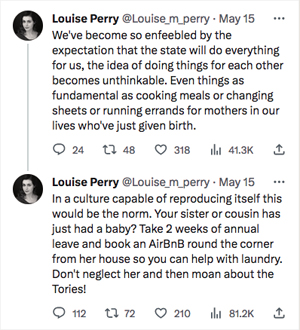
The problem with this position is that it is simply a flip to the situation that Federici and others were resisting. In a capitalist economy, unpaid labour is unvalued labour. And women who work for free to care for others have to get our own needs met somehow, which means, in the traditional (patriarchal) family model advocated by Perry and Harrington, being ‘provided for’ (i.e. dependent on) a man who is paid for his work. ‘Reactionary’ feminists have no quarrel with men getting paid for the work they do outside of the home, but have assumed that valuing interdependency means requiring women to care for free. That sounds rather a lot like unvaluing to me.
Valuing care cannot be done by treating it as nothing but time spent on wage-labour, but it also cannot be done by pretending it costs nothing to the people who do it. The reality of care is that it happens in interdependent relationships, but those relationships are not necessarily equal. A woman cannot get all her needs met by her infant child, and should not be expected to. Different people need different amounts and types of care at different times, which means that, while care is a relational process, it is a process in which resources are passed from one to the other in an uneven flow. An ethical modality of care values these resources, and so it looks for ways to meet the baby’s needs without destroying the mother.10 This requires that she herself needs replenishing. Valuing care means acknowledging that it often involves love, but also that it can be fucking exhausting and that everyone needs a break and to be cared for themselves, not to mention the opportunity to pursue other potentialities and possibilities in our lives.
Valuing care means embracing interdependency, and that means making sure that carers get their needs met just like everyone else. Eva Kittay argues for an ethic of care – which she calls doulia – that assumes collective, public responsibility for caring for those who give care to others.11
“Just as we have required care to survive and thrive, so we need to provide conditions that allow others – including those who do the work of caring – to receive the care they need to survive and thrive.” – Eva Kittay12
From this perspective, we acknowledge the need for loving care and that those who give it are doing something deeply valuable and necessary (because humans are not, it turns out, cyber-warrior-mushrooms). We also acknowledge that those who give care are full human persons with their own needs and interests, and that as a society we have a responsibility to organize in such a way that people can give care (for example through mothering) without being exploited and losing the possibility of self-determination.
What might this look like? I think the state (which is our mechanism of collective material responsibility) could provide resources to enable webs of caring relation. Examples of ways to do this might be universal basic income, grant funding for community-led childcare and neighbourhood-based elder care, and shorter working weeks (combined with higher wages) so that we all have more time and energy to support one another. These types of policy, which put money in the hands of those who do the caring, might help to enable a society less driven by cyber-warrior-mushroom logic, and more supportive of everybody’s role in caring for everybody else.
Rose Rickford is a radical materialist feminist and a lesbian. She spent her early 20s in the ‘queer’ scene and will be forever grateful to the woman who pointed out to her that gender is a hierarchy, not a pick-and-mix. Twitter @roserickford.
1 Editor’s philosophical wibble: This refers to aspects of the feminist critique of the social contract theory, which assumes that human society begins with individuals in a state of nature, and that social relations are then grafted onto them. Thomas Hobbes’s version of social contract theory has been critiqued by feminists for the individualism inherent in his claim that in the state of nature, we should “consider men as if … sprung out of the earth, and suddenly, like mushrooms, come to full maturity, without all kinds of engagement to each other” (De Cive, 1642). See for example ‘Masculinity As Ideology in Political Theory: Hobbesian Man Considered,’ Christine Di Stefano, Women’s Studies International Forum, 6.6 (1983), 633-44. See also the discussion of Hobbes’s ‘mushroom-man’ metaphor in Conceição Soares, ‘The Philosophy of Individualism: A Critical Perspective,’ International Journal of Philosophy and Social Values, 1.1 (2018), 11-34. Soares’s paper argues that the “Western world is based, by and large, upon the dominant modern theory of free, equal and autonomous individuals in open and symmetrical competition in a free marketplace of commodities and ideas. Its fundamental assumption is the conception of the individual as an isolated entity separated from its own environment, living as a self-sufficient being.”
2 Editor’s philosophical wibble: This is a reference to Hegel’s ‘Master-Slave’ dialectic which suggests that we always narcissistically aim to impose our own sovereign self-image onto the other and that, therefore, a fundamental hostility structures human consciousness and human relation. See G. W. F. Hegel, The Phenomenology of Spirit (1807) and Alexandre Kojève, Introduction to the Reading of Hegel (1947). De Beauvoir attended Kojève’s lectures in Paris in the 1930s, and his interpretation of the Master-Slave dialectic strongly influenced her analysis of the position of ‘woman as other’ in The Second Sex. Many feminist thinkers have critiqued this aspect of de Beauvoir’s thought for accepting that human relation is structured by fundamental hostility, and pointed to the maternal dyad as evidence that human consciousness does not arise in a situation of the ‘fight to the death for pure prestige’ as suggested by Hegel/Kojève.
3 One might wonder how the great cyber-warrior-mushrooms are able to do things like build pyramids without an ounce of cooperation with anyone else, but that would, I suppose, be to underestimate their great greatness.
4 Silvia Federici, Revolution at Point Zero: Housework, Reproduction, and Feminist Struggle (Oakland, CA: PM Press, 2020), p. 11.
5 Silvia Federici, Wages Against Housework (Bristol: Falling Wall Press and the Power of Women Collective, 1975), later republished in Federici, Revolution at Point Zero.
6 As can, under the right circumstances, growing food, building houses, making clothes, and writing books. It turns out that capitalism isn’t a great way of supporting people to be nourished by their work in general.
7 See Abraham H. Maslow, Toward a Psychology of Being (New York: John Wiley & Sons, 1968).
8 Louise Perry, ‘The feminist case for marriage,’ The Spectator, 29 May 2022.
9 Mary Harrington, ‘The three principles of reactionary feminism,’ Public Discourse: The Journal of the Witherspoon Institute, 30 April 2023.
10 I mean this literally and metaphorically. The mother-infant relationship is, of course, not the only care relationship, but it is an axiomatic one, because to support mothers, and value the time and energy that goes into caring for babies, is to acknowledge dependency.
11 Kittay developed doulia as an adaptation of ‘doula.’ She writes: “Doula originally meant slave or servant in Greek. It is intriguing to redirect the concept and signify instead a caregiver who cares for those who care for others… Extending the notion of the service performed by the doula, let us use the term doulia for an arrangement by which service is passed on so that those who become needy by virtue of tending to those in need can be cared for as well… Doulia is part of an ethic that is captured in the colloquial phrase ‘What goes around comes around’… the etymology of doula as slavery is instructive as a contrast to the principle advocated here.” Eva Feder Kittay, Love’s Labor: Essays on Women, Equality and Dependency (Milton: Taylor & Francis, 2019), pp. 116-17.
12 Kittay, p. 116.